Preview

Overwatch Rush
Blizzard's First-Person Hero Shooter Goes Top-Down
During my recent trip to Blizzard Entertainment’s headquarters, I received a discreet invitation to a small gathering with a new team that’s been working on a secret project set in the Overwatch universe. The new game, Overwatch Rush, is a top-down multiplayer twin-stick shooter in early development for smartphones and tablets. Helmed by Blizzard’s Barcelona team, the standalone spin-off manages to smartly convert Overwatch’s essence into a surprisingly easy-to-control mobile adaptation.
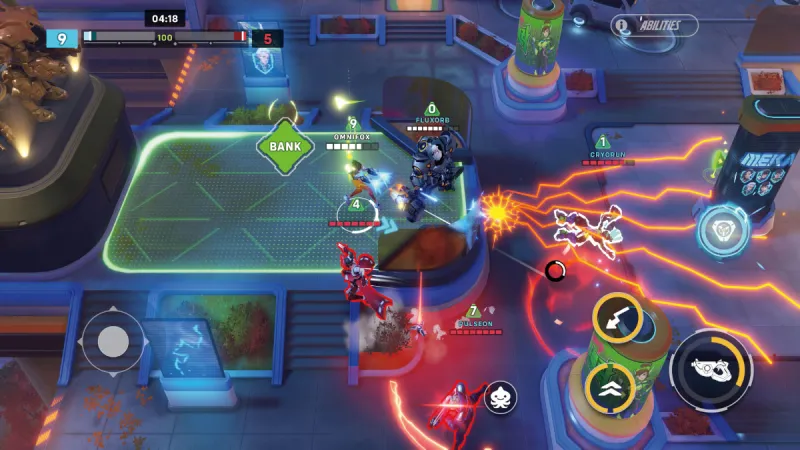
Despite the genre shift, Overwatch Rush is surprisingly similar to the main game, incorporating many of the same characters and mechanics (exact copies, in several cases), but offers the ease of access mobile games are known for. The free-to-play shooter features intuitive touch controls, including tap and hold buttons to activate character abilities, a dedicated virtual analog stick for movement, and a secondary directional stick that doubles as the character’s primary fire. There is a small amount of auto-aim present, but you’ll still need to master the fundamentals to reach the top of a surprisingly high skill ceiling.
While the team’s goal is to introduce more heroes from the base game slowly, Overwatch Rush’s launch roster currently includes Tracer, Reinhardt, Kiriko, Soldier: 76, Lucio, Pharah, Mercy, and Reaper. Many of these heroes are one-to-one adaptations, but characters like Mercy have undergone significant changes. In Overwatch Rush, Mercy channels her battle medic persona, swapping her primary fire from her signature Caduceus Staff to her typically secondary blaster. You can tap her Blessing ability to self-cast or attach a simultaneous damage and healing boost to an ally. Additionally, Mercy has a directional boost that allows her to reduce or increase her distance from battle at will, and notably, enables her to fly alongside airborne heroes like Pharah. While Mercy has an area-of-effect resurrection ability, Blizzard has completely reworked her ultimate ability to be a damage and healing aura that affects players in proximity.
Repeatedly playing a hero earns you mastery levels, which unlock new mods and talents. Mods include minor hero improvements like decreased ability cooldowns, bonus health, and heal boosts. In contrast, talents offer more significant game changes, like causing Reinhardt’s Fire Strike to trigger a fiery tornado that sucks opponents into a central area. Alternatively, talents can alter Tracer’s recall to grant overhealth or imbue her Blink ability to deal damage if she passes through an enemy. While you can’t swap heroes mid-match, which are over in under five minutes, you can change loadouts if your selected build isn’t performing well.
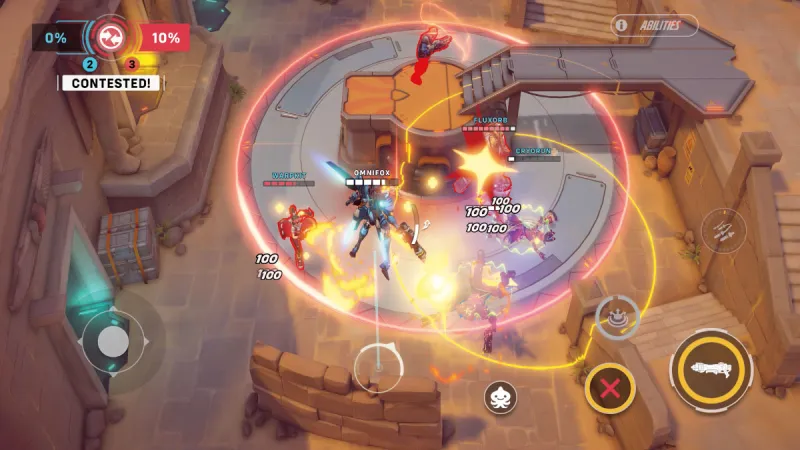
Players compete across multiple modes, including familiar staples like Control Point and new ones like Nano Grab. The latter pits two teams against each other, requiring them to collect 100 green tokens, called Nanos, and deposit them in scattered banks that activate for only a short time, similar to a King of the Hill ruleset. Killing other players causes them to drop the Nanos they’re carrying, creating a satisfying risk-and-reward element.
While I’m still skeptical as to whether the project can stand on its own legs without any progression ties to Overwatch, it does feature substantial cosmetic rewards you’d expect from the series’ signature loot boxes. Overwatch Rush won’t release anytime soon, but I’m curious to see if Blizzard can capture a new, casual audience for one of its flagship series.
On
On
Off
Off
Products In This Article