Kenta Motokura, producer of Donkey Kong Bananza

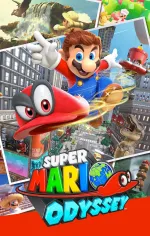
Last year's launch of Nintendo Switch 2 ushered in a new era for the most iconic name in video games, and while Nintendo was building its nascent platform, it chose a game about destroying everything in sight to be one of its flagship titles. That game was Donkey Kong Bananza, which arrived from the team that released another game that helped bring Nintendo into a new era in 2017: Super Mario Odyssey.
Donkey Kong Bananza stood alongside Mario Kart World, Metroid Prime 4: Beyond, Kirby Air Riders, and others to announce the Switch 2's presence as a continuation of Nintendo's most successful home console of all time. However, despite a busy release calendar full of recognizable and anticipated titles, Donkey Kong Bananza, with its trademark destructible environments and enemies, stood above the rest, earning a 9 out of 10 from Game Informer and taking home the award for the Best Nintendo Game of 2025.
Fresh off their panel at the Game Developers Conference, in which they spoke about the impact of using voxels, small three-dimensional units of data, to accomplish the levels of destruction on offer in Donkey Kong Bananza, we sat down with producer Kenta Motokura and programmer Tatsuya Kurihara. In addition to talking destruction, we also dove into the redesign of Donkey Kong, the presence of elephants in both Super Mario Wonder and Donkey Kong Bananza, and how development started on Switch 1.
Coming off such a beloved game like Super Mario Odyssey and turning to the gameplay style of Donkey Kong Bananza, what were the initial ideas behind making everything destructible, and how did you determine if it was even technically feasible?
Kenta Motokura, Producer: My boss, Mr. [Yoshiaki] Koizumi came to me and asked if we could create a Donkey Kong game using the same team that had worked on Super Mario Odyssey. I felt there was a lot of potential in using voxels, and so that was something that, as we talked to our engineers, wanted to see what they could do with the idea as well.
Tatsuya Kurihara, Programmer: This idea that using voxels to create destruction was something that, from the early stages, we felt had a lot of potential to be fun, but when it came to whether it's technically feasible or not, that's a different story. And to be honest, early on, we weren't sure if it was going to be feasible, and that's something that we worked through as we created and worked on the game.
KM: We had a lot of different ideas for how to approach this, and did a lot of prototyping and really layering those one on top of another to create an overall experience, but the end goal is, of course, to pull all this together into something that feels like a comprehensive game. That was where we wanted to end with Donkey Kong Bananza.
When this idea was pitched of, "It would be fun to create all of this destruction," was there ever a conversation of how much should be destructible, and then when the answer was "pretty much everything," what was the reaction?
TK: The idea of wanting to have everything destructible was something that we kept in the forefront of our minds as we're developing. And so, those [things] that we felt we might not be able to destroy, we kind of put to the side and try to make sure everything we put into the game as we're making it is actually destructible. As we were developing dev documents or pitching ideas, when something comes in that's unbreakable, something would, at some point, would be like, "Can we just make this breakable?"
KM: Whenever you are trying to approach a new endeavor, it's really important that you create a deep, shared understanding across the whole team from the very beginning. That doesn't really end after just one conversation, so you have to have a lot of ongoing conversations throughout the process to make sure that you're bringing everyone along.
So we would have each of these individual episodes where someone would model something in Maya and they would say, "Oh, should this be made of voxels?" And we'd say, "Yeah, let's do it!" And then they'd bring us another one and they'd say, "This too?" and we'd say, "Yeah, let's do it!" But every time you create new levels, new objects, new prototypes, and you start to play with those, then the team starts to understand the vision for the whole, and you see the alignment come together.
It seems to be that, in this era in particular, Nintendo is so about experimentation and brainstorming fun ideas. I had that conversation with [producer] Takashi Tezuka and [director] Shiro Mouri about Super Mario Bros. Wonder, and them coming up with all the ideas for Wonder Effects. It sounds like there was a similar, amazing environment of experimentation within the Donkey Kong Bananza team, as well.
KT: For Donkey Kong Bananza, just like Super Mario Bros. Wonder, there was a lot of prototyping that was done. That ranges from what kinds of fun gameplay experiences we can provide and create using voxels, to what types of destruction [we can] bring to the game, to what kinds of bosses and enemies we want to see. This might be a split opinion across the team, but for myself, personally, when we're prototyping, I tend to lean heavier into the chaos side of things and try these prototypes out.
KM: Whenever we're prototyping something, usually we're starting with the theme – some sort of central idea – and then it's about, "How do we raise the function to the level of that theme to fully express it?" For some people on our team, the idea of going beyond the regulations of what we would normally do in creating something is a really fun moment of freedom for them. The central idea is that if that prototype, then, is fun, it will go into the game. I really think that motivates the team to think along those lines.

While on the topic of the environment of experimentation, Donkey Kong Bananza also encourages the player to experiment. When you were playtesting, did you notice that the game was pushing you to experiment not only as a developer, but also as a player?
KM: Certainly. I think that when we're playing, we need to hold two different kinds of understandings at the same time: one as makers, and another as players. We try to keep that in mind: this idea of, "How will the player want to play?" And we don't want to get too far away from that concept. We want to make sure that all of the reactions and the interactions within the game are along those lines.
TK: For myself as a game developer, when I get to the phase of playtesting, I feel like I put myself more in the shoes of a player. This was something I did back in Super Mario Odyssey, as well, where I would combine all these skills and techniques and tricks to try to get to this one place that doesn't look like I'm supposed to be there, but I try.
When it comes to Donkey Kong Bananza, I would try things like getting together a bunch of voxels and creating a pathway to get to this area that, again, I'm not potentially supposed to go to. And so, even during development as a developer, I try to make sure that I have fun and play the game as a player to experience and be able to craft that experience for the player.
KM: I remember some moments in Super Mario Odyssey where there was some terrain where players might be able to get up that particular area, and we would say among the team, "Okay, don't fix that, because people might do it and enjoy it."
A few years ago, I had a similar conversation with [producer] Eiji Aonuma for Tears of the Kingdom when I asked him about how people can use the Ultrahand ability to bypass something in a way that was intentionally designed to be completed in a different way. You hinted at how you feel on the topic, but what is your philosophy on seeing players approach and complete parts of the game different from how you envisioned it?
KM: When you have people playing the game, you want there to be clear lines of play that are understandable; they know what they're supposed to be doing, but not necessarily how. You don't want to make it entirely inscrutable. You want to give them the freedom and the opportunity to use their own will and own ideas to create the conditions that lead to success.
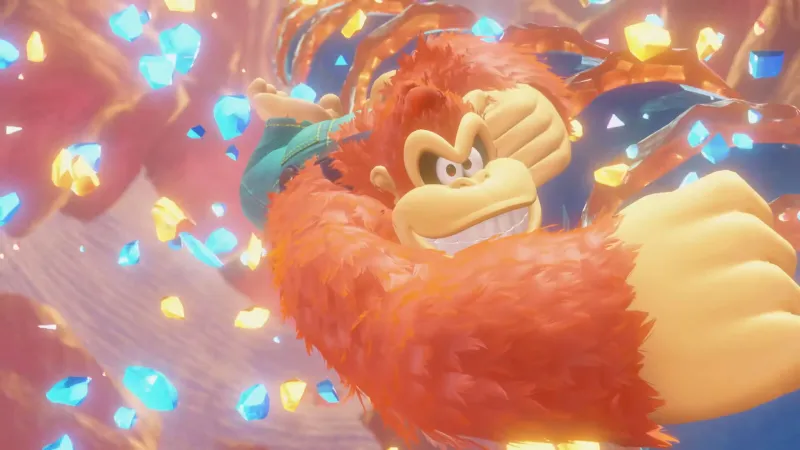
One of my favorite parts about the destruction was that it wasn't just a convention used in the environment, but with many enemies and bosses as well. Did the idea of playing off the destructibility come after the idea of making the level so destructible, or did extending that concept to the enemies go hand in hand with the levels' destruction?
TK: It was pretty early on in development, because when we cast our goal to create everything voxel, everything destructible, then, you know, naturally the enemies will have to also be destructible voxels, so it was very early on in development. So then, the idea of brainstorming and ideation of what the boss encounter is going to be like is with the understanding and premise that they're going to be voxels. And with this understanding, how do we make an interesting, fun, engaging boss encounter?
The Bananza Transformations go together with the core destruction, often taking it to new levels – even beyond what Donkey Kong can accomplish in his normal form. How did you go about prototyping and making it so they were balanced and not causing too much destruction? Or was it more of "the crazier, the better"?
TK: I think we can agree the most destructive transformation is the Elephant Bananza, and honestly speaking, it probably went too far. But at the same time, it's fun, it feels good. And that's what matters most.
KM: Because our goal is to make playful destruction possible within the game, we wanted a slightly different structure than what you would have found in, say, traditional Mario games, where you have to encounter or have in your possession items to be able to transform. We wanted, in the case of Donkey Kong Bananza, for Donkey Kong to be able to transform anytime to up the destruction.
A couple years prior, we had Super Mario Bros. Wonder, which also famously included an elephant transformation for its heroes. Did you already have an elephant in Bananza at that point and did you see that and go, "Oh no, they beat us to it"?
KM: To be honest, the fact that we both had elephants was a complete coincidence. When I think about how the elephant transformation works in Super Mario Bros. Wonder, it's clear to me that there were different goals for what they were trying to accomplish, even though it's the same animal transformation, so I didn't worry about it too much from that perspective. However, if they were vacuuming out blocks in Super Mario Bros. Wonder, I would have been a little bit worried! [laughs]

How did this level of destruction alter the way you designed levels when compared to something like Super Mario Odyssey?
KM: I would say that, fundamentally, the idea of how a player gets from point A to point B in a 3D platformer is still the same. When you have a game in which all of the terrain is breakable and the player might be encountering new things that are hidden inside, there are moments of discovery. I think that there's a really big potential in a game like this for those moments of discovery and more surface area that can be explored – even the inside of – than a game like Super Mario Odyssey.
But we have to think about the placement of all of these elements, and not even just the ones that are visible: the ones that are hidden, as well. And that brings a different kind of challenge into level design where you really have to have all of these placements correct throughout the world and inside of it. I imagine there's probably some interesting, new approaches on the tech side, as well.
TK: Different from a 3D platformer like Super Mario Odyssey, you've got to think about what can break, and also what's inside when you break that, so I imagine it was a lot of work for the level designers. So, in order to support the work of the level designers have to do to create those little discoveries or things that can be found after breaking the terrain, we added features to the level editor that made it easier for them to do that. There's also a feature that we added to the level editor that's basically like a "break all" button that basically breaks everything and shows you what's hidden inside. Those are some of the things that we implemented and changes we made to our approach.
Donkey Kong Bananza does a great job of encouraging the player to break as much stuff as possible, but was there every a worry that players wouldn't engage with the destruction as much as you hoped?
KM: No, we didn't have too much concern about that point exactly. The reason for that is, if I think of destruction compared to making something, I think it's an easier action to undertake. You'll see that with kids at play; it's very difficult for them to create something beautiful, but they have a fantastic time destroying things. And we want that cycle of destruction to continue; we want people to stay in that gameplay loop. So, we put a lot of thought into, "Which object should we have? Where should we place it, exactly?" That was a lot of deliberation for us.
TK: Another thing we kept in mind as we were creating the game was to create an environment where players don't hesitate to break anything or destroy anything. For example, if a player decides to just keep digging themselves underneath, and if they find themselves stuck and can't go any further, they'll think, "I'm just not going to dig anymore." So, to prevent that, we gave DK the ability to climb. So, all of the abilities and settings around the game are really to encourage the player to rain destruction.
I think a lot of people look at it as a game that would only be possible on the Switch 2 rather than the Switch 1 given the levels of destruction. Was there ever a version in development for the Nintendo Switch 1, and how different was that version?
TK: We had initially began development on this game as a game for the Nintendo Switch. As we progressed with development, it was then decided to make this a Nintendo Switch 2 game. But throughout all of that process, the core idea of destruction hasn't changed. When it came to the power specs for Nintendo Switch 2, we got to the point where we needed to decide where we were going to use that spec. And we decided, "Well, this is a game about destruction, so let's take all of that and pour it into destruction." So, you know, figuring out ways to make the destruction even more grand and even more fun.
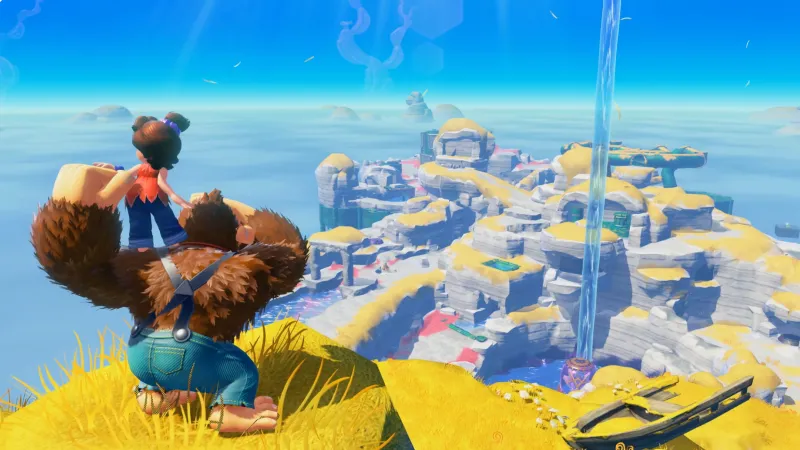
When you learned about the Nintendo Switch 2's upgraded power and the decision was made to move Donkey Kong Bananza to Switch 2, how much of a relief was it when you realized you'd have much more power to work with?
TK: It was certainly great. I just had more memory to work with when dealing with the voxels, and that was certainly welcome.
The reveal of Donkey Kong Bananza was such a surprise for so many people. A lot of people were expecting the next 3D Mario to be revealed at the Switch 2 event, and then suddenly it's Donkey Kong in front of everyone. What was it like for you to see people so surprised and excited that a new Donkey Kong game is coming, particularly since it had been so long since a 3D Donkey Kong had been released?
KM: Honestly, I didn't have any idea how people would react prior to the announcement the whole time I was working on it! So, when I finally got to see people's reactions and they were happy, I was really overjoyed. Especially considering that Donkey Kong has such a long history as a character and so many fans, I wanted to make sure that I was making those people happy. That was really gratifying.
Considering so many legendary studios and developers have worked on Donkey Kong video games, dating all the way back to Shigeru Miyamoto, and then the years with Rare, and then Retro Studios, how did you go about creating a new entry that has a very unique identity, but still respects and preserves the lineage of all those games?
KM: For us, the process of creating a Donkey Kong game and thinking about the Donkey Kong character really started with a lot of research. So, we looked at all these previous titles, sometimes from different studios, to think about what sort of characteristics each brought to the idea of Donkey Kong. And so, we were thinking about how the character appeared in each of those games, as well as what sort of images people had of the character over the years when we were trying to decide how Donkey Kong should be in Donkey Kong Bananza. I think what we ended up with was, in one sense, like a summary of all of those images and those ideas from the past.
One thing that stood out for me as kind of interesting about the character is this sort of dichotomy he has where, like, [on] one side he's kind of wild, and on another side, he's kind of goofy and approachable. And so that, along with the fact that he takes on new challenges, as well as these previous titles have done, emboldened us to think about new technology, and that helped to define the themes that I was then able to present to the team.
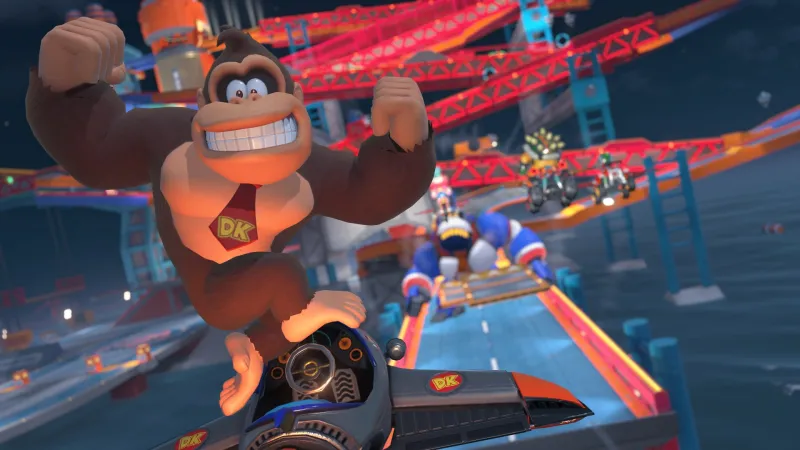
One of the things that has occurred in the Nintendo Switch 2 era is that when we saw that very first look at Mario Kart World, we noticed we had a new Donkey Kong character model that looks a bit different from the version that started showing up in Donkey Kong Country in the '90s. Did the Donkey Kong Bananza team initiate that redesign, or was that planned for Mario Kart World first?
KM: I think it was all a through line of that thinking and that research that I was just talking about with the concept of what Donkey Kong is, or how he should be in this game. And so, that conversation about, "Which characteristics are we going to bring forward in this character?" was something that was really deeply informed by, in a sense, the parent of Donkey Kong, Mr. Miyamoto, as well as conversations with Mr. Koizumi, who's worked on Donkey Kong titles, to come up with, "What's the appropriate expression for this character? What's the most important thing? Is it his strength?" for example.
That carried through to design, as we were able to express each of those beats. That was the origination of this basic model for Donkey Kong as a character in Donkey Kong Bananza, and that was something that was transferred to Mario Kart World for use in that project, as well.
Was there a moment of, "We've got to get on the phone with them and let them know before they get too far into development"?
KM: No, I think there was a natural order of things, actually. You know, what we were talking about at the time was, how best to position these things for Nintendo Switch 2 to communicate the charm and the value of the system. But I think on the Mario Kart World side, the had their own ideas about how they wanted to express Donkey Kong as a character, even beyond the model.
It seems that reception for Donkey Kong Bananza has been largely positive from my perspective. How has the reception been for you, and does this indicate that we might not have to wait so long for another mainline Donkey Kong game?
KM: I guess maybe what stands out to me is the idea, first of all, that Donkey Kong, as a character – and this is true for Mario as well – really are a part of Nintendo. And so, for us, it's almost like we're borrowing them to create software with. For me, being able to see people have fun once again with the character of Donkey Kong helps me communicate the potential for that character. I have a sense of relief knowing that's something that people can enjoy in the future as well. Unfortunately, I can't talk about any specifics of future plans at this time. [laughs]

Bad signal or dead zones? Download your issues before you leave and read anywhere.


![Remedy Explains Control Resonant's Most Memorable, Unexpected Sequence And Its [REDACTED] Inspirations](/sites/default/files/styles/teaser_promoted_image_thumbnail/public/2026/06/04/6db2d411/control-resonant-sgf-2026-7.jpg.webp)