interview

Interview: World of Warcraft Lead Composer On Making Of Midnight’s Human-Made Music
World of Warcraft: Midnight launches next week, but early access begins later this evening. Ahead of the MMORPG’s anticipated expansion, we sat down with World of Warcraft’s lead composer, Leo Kaliski, to learn about the making of Midnight’s music and how the team is flexing its creative muscle with new instrumentation. Finally, Kaliski counts himself lucky to make human music in a world obsessed with generative AI.
In your journey from composer’s assistant to lead composer, I'm curious how you’ve come to understand the musical identity of World of Warcraft. What does it sound like to you?
Some of my understanding comes from being a fan of the game; I've played World of Warcraft since vanilla. It's a pretty broad and diverse musical identity. I worked on Diablo for a few years [...], and it has a much narrower musical identity. It's very dark [with] the 12-string guitar, the synths, and the reverse [effects]. There's a very clear musical language for Diablo. Warcraft is very broad. The list of things that aren't WoW is almost shorter than what is WoW. We don't use sawtooth dance synths. Stuff like that isn’t really WoW. But a couple of years ago, the answer would probably have been, “We don't really use guitar.” But then we did a Goblin Jazz patch that had a bunch of guitar on it, and coming up in Midnight, there's a bunch of distorted guitar in some of the zones, which wasn’t a thing before now.
World of Warcraft’s sound is largely dictated by the game’s art. What is the game asking us to do? It's about being in the background. We are there to support the gameplay and the story [...] without overstepping the boundaries, without making it about us — unless it's like a big cinematic moment. It's about being in the background, but trying to find cool ways to do it.
Light and dark are major themes in Midnight. How did you channel that overarching theme, and what was its role as you composed music for the expansion’s new zones?
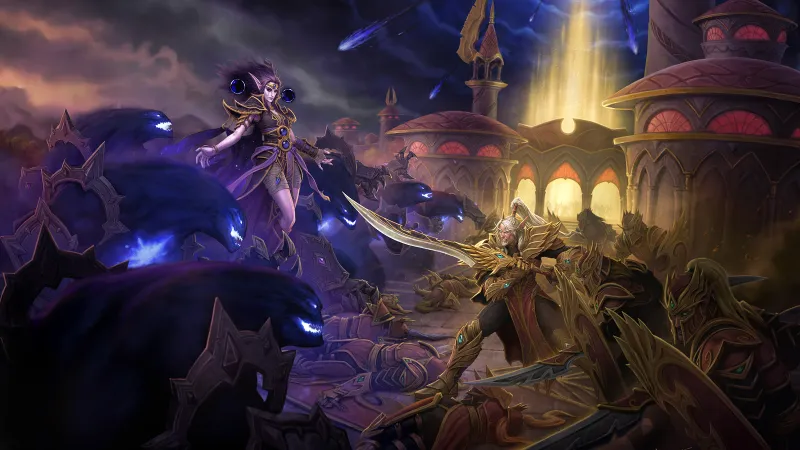
The Light-versus-Void [theme] was a top priority when we first started working on the expansion. Those were some of the very early themes we worked on. The Light has a very specific theme, whereas the Void came more about from [looking at] Xal’atath’s army, The Devouring Host. We wrote those themes separately and then combined them into a battle track that has the two weaving into each other. Something great about World of Warcraft is even when there is an overarching story of Xal’atath’s attack, [...] you go into a zone, and there’s still a local story going on. [Characters] have their own local problems they're dealing with, and you're helping them because everyone being on the same footing helps you win this bigger fight versus the Void.
Were there any challenges in incorporating new instrumentation styles, like the aforementioned distorted guitars, into what is traditionally a very orchestral sound identity?
You're right. World of Warcraft is traditionally orchestral. The reason the distorted guitar felt right here is that we're using it for the new zone, Voidstorm. It's in the void, and it has all these very angry, aggressive beasts. [The zone] has this theme of predation: the strong eating the weak to get stronger. And I remember being on a zone tour with Voidstorm’s lead, and they said they were trying to make the zone feel as metal as possible. And I was like, “That sure sounds like distorted guitars to me.”
So it started as an experiment [...] and the challenge became, “How do you get it to blend into the background? How do you make it less distracting for players?” We’ve made sure it has a good amount of reverb and that we’re not using it too often.
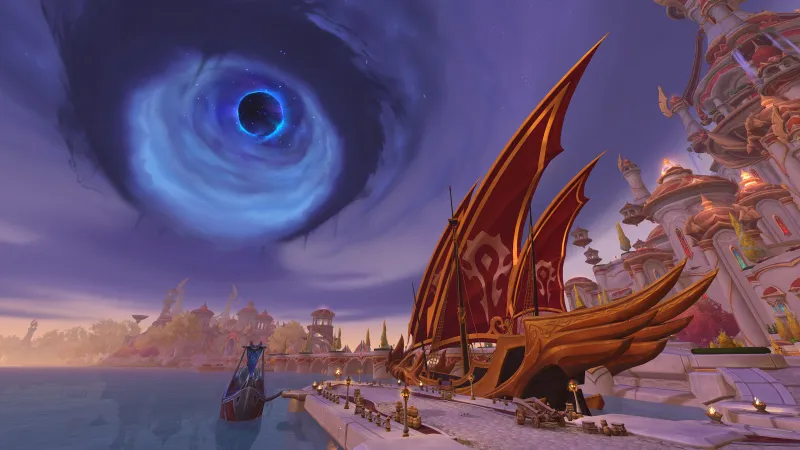
We’re going back to the home of the Blood Elves, first created two decades ago, in Midnight. Is that legacy reflected in your new work?
The first priority was preserving those original themes as much as possible. There's a lot of love for the original Blood Elf music, and we didn't want to erase that with completely new music. So There are a few pieces of music in Midnight that directly quote the original material with a new coat of paint. It’s higher fidelity because we can record higher-quality stuff now than we did back then. But then there's music that's more of an evolution, where we use the same instrumentation — Blood Elves are all about the solo cello and the harp — but we’re not directly quoting original themes. It still feels related and in the same pocket. There are pieces where it's solo violin instead of solo cello, so it still feels similar, but it's a little brighter and less melancholy. And that’s because the zone has changed. It's not the same zone as it was back then, and they’re not the same culture. They’ve progressed as people.
The scar down the middle [of the zone] is gone. The Ghostlands are gone. [Quel’Thalas] is much greener and more vibrant. It made sense to honor the original themes while also making them brighter and bigger.
Which instruments did you reach for when composing music for Harandar? The new zone seems untamed and steeped in mystery.
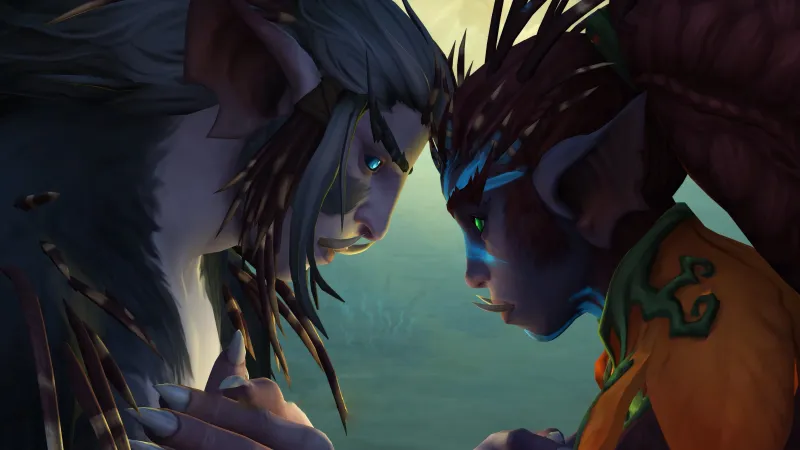
That one had quite a bit of exploration to start with. [The Haranir] are an all-new culture, an all-new race. But they’re also not totally alien and foreign to WoW. They feel similar to [elves and trolls], in a way. So it wouldn't have made sense to do something that was a complete departure from that. Early on, there was a lot of discussion with Chris Metzen and other story people [to learn] what the Haranir are about. [...] They're very defensive and can be aggressive and primal. They don't like outsiders. But once you earn their trust, they're very kind people. We tried to find a way to incorporate those elements. Looking at the art, there are big mushrooms and bioluminescent areas.
I did a first pass at exploring the music, and it was coming along. Some of it felt right: the bowed textures, the percussion, and pluck sounds. It still wasn't quite right, so I handed it off to one of our composers, Adam Burgess, who has always been good at non-orchestral music. He keyed in on this vocal [style], which is super cool, and it’s not one we’ve really used a lot in World of Warcraft. It features chants and pockets [of] vocal interjections. Less of a singing a melody. It feels more primal, [...] almost like using a voice as an instrument rather than someone performing.
And it was exactly what the zone needed to make it feel alive and to make the [Haranir] culture feel well represented. You can almost imagine the voices [in the track] are them. [...] That's one of the secret sauces of World of Warcraft: we're not a one-person team. As the lead, I'm not dictating what something should sound like. It's about giving the right assignment to the right person and letting them express themselves. Nine composers contributed to this expansion, each with their own voice. That kind of melting pot is what makes the soundtrack so special.
Tech companies are hellbent on disrupting every industry with the rise of generative AI. How has this moment in time affected your experience as a seasoned composer working in video games?
I feel lucky that AI in music still feels quite a way off. Sometimes you look at AI photos, and if you don't look closely, you might not know it's AI. Music is not there yet. Usually, you hear it, and you instantly know something is not right about it, or the fidelity isn’t there. So in some ways, it's not as top of mind as it probably is for other artists. I think we here at Blizzard feel very lucky and happy that we're not using generative AI. We're just writing what we think is cool, and are happy to do that. That's my stance.
On
On
Off
Off
Products In This Article