
Preview

Beastro
A Tasty Sample Of This Cozy Cooking Deckbuilding Roguelike
Like cooking a tasty dish, Beastro tosses several different ideas into a big pot and blends them into an enjoyable experience. During the week of The Game Awards, I played an hour-long demo of the cozy cooking deckbuilding roguelike and found it a fun sampler for the full course coming next year.
Beastro centers on a sous chef named Panko who resides in the peaceful, artisan village of Palo Pori. A protective wall surrounding the settlement keeps out the darkness stirring outside, namely monsters that have overtaken the wilds. When Panko’s teacher goes missing, he receives help in the form of a guardian spirit named Flambe, a raccoon-like living flame. In a fun twist, Panko’s job isn’t to save the town but rather to run a restaurant and feed the band of heroes, called Caretakers, whose job is to venture beyond the wall to confront the darkness. By helping them, Panko may be able to find his lost mentor.
The game’s day-to-day structure reminds me of Dave the Diver’s, in that each day is divided into three segments. The morning begins in a laid-back fashion, as players gather ingredients in preparation for the restaurant’s opening. I enjoyed strolling through the scenic village to pick up grubs to feed chicken-like birds, catch fish at the pier, and tend to a garden of crops. It’s standard cozy fare, but it’s a nice calm before the busier storm of running the restaurant.
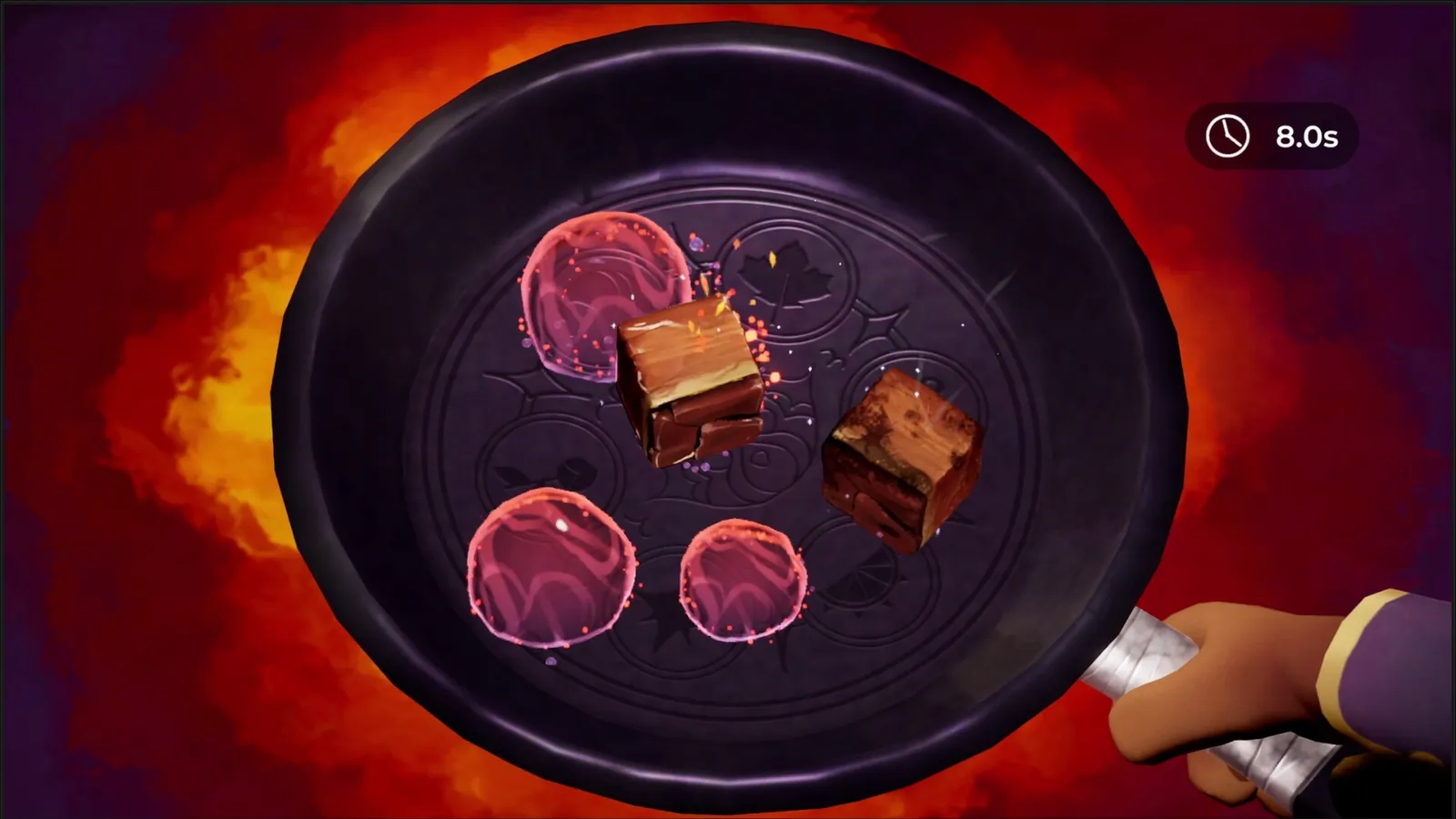
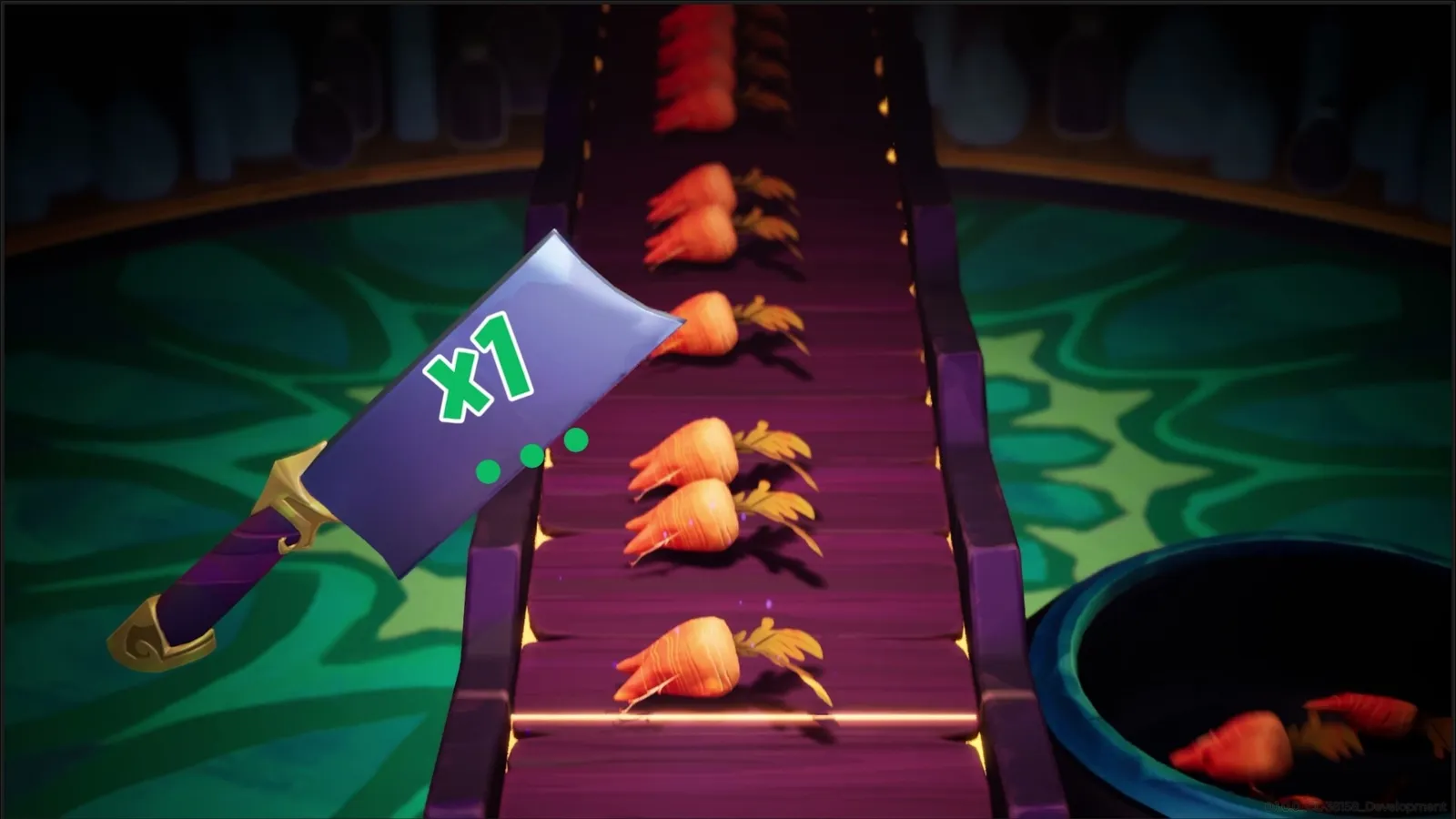
Once you’ve gathered your desired ingredients, it’s time to open your eatery to the masses. After determining the menu based on the ingredients you’ve obtained, preparing dishes became my favorite activity. Cooking unfolds as fun, carnival-like mini-games. I chopped veggies as they quickly descended a long cutting board, offering an enjoyable test of speed and timing. Sauteeing involves skillfully turning the pan to keep food from touching harmful pan bubbles. Boiling requires shooting ingredients like a basketball into three different pots, with highlighted pots netting a higher score (note to culinary novices: please never chuck food into boiling pots of water). Completed dishes must then be quickly delivered to patrons. Easy peasy, though Caretakers have more specific tastes and introduce more strategic depth to recipe crafting.
A Caretaker with a reservation arrives during each dinner service, eager for a good meal to fuel their excursions beyond the wall. During my service, a friendly Caretaker named Oyshi strolls in requesting a dish that satisfies his particular craving for eggs. Feeding Caretakers builds their card deck, which they’ll use to combat monsters during expeditions (more on this soon). Step 1 is selecting a recipe base by placing Tetris-shaped ingredients with flavor profiles on a grid. Ingredients have one of five flavors: Umami, Salty, Sour, Bitter, or Sweet. These flavors also have a weight that determines how strongly they affect the flavor profile.
Adding ingredients changes the flavor profile of the dish, and the goal is to assemble a deck that matches a Caretaker’s likes and dislikes. Appealing to their tastes can provide health and attack boosts, as well as deepen your friendship with them. The finished deck will consist of the cards and abilities gained from eating. This mechanic sounds more complicated than it is, and I gained a stronger understanding of this system once I applied it to combat.
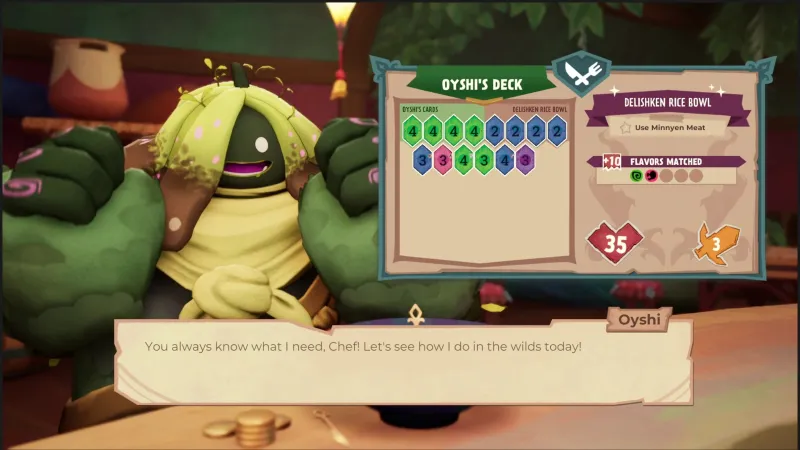
Closing the restaurant transitions the day into evening. It’s time to visit a Caretaker, Oyshi in this case, who will recount their adventure in the form of a cute puppet show. This initiates a standard roguelike adventure where you navigate branching paths filled with combat encounters and other pitstops en route to the end.
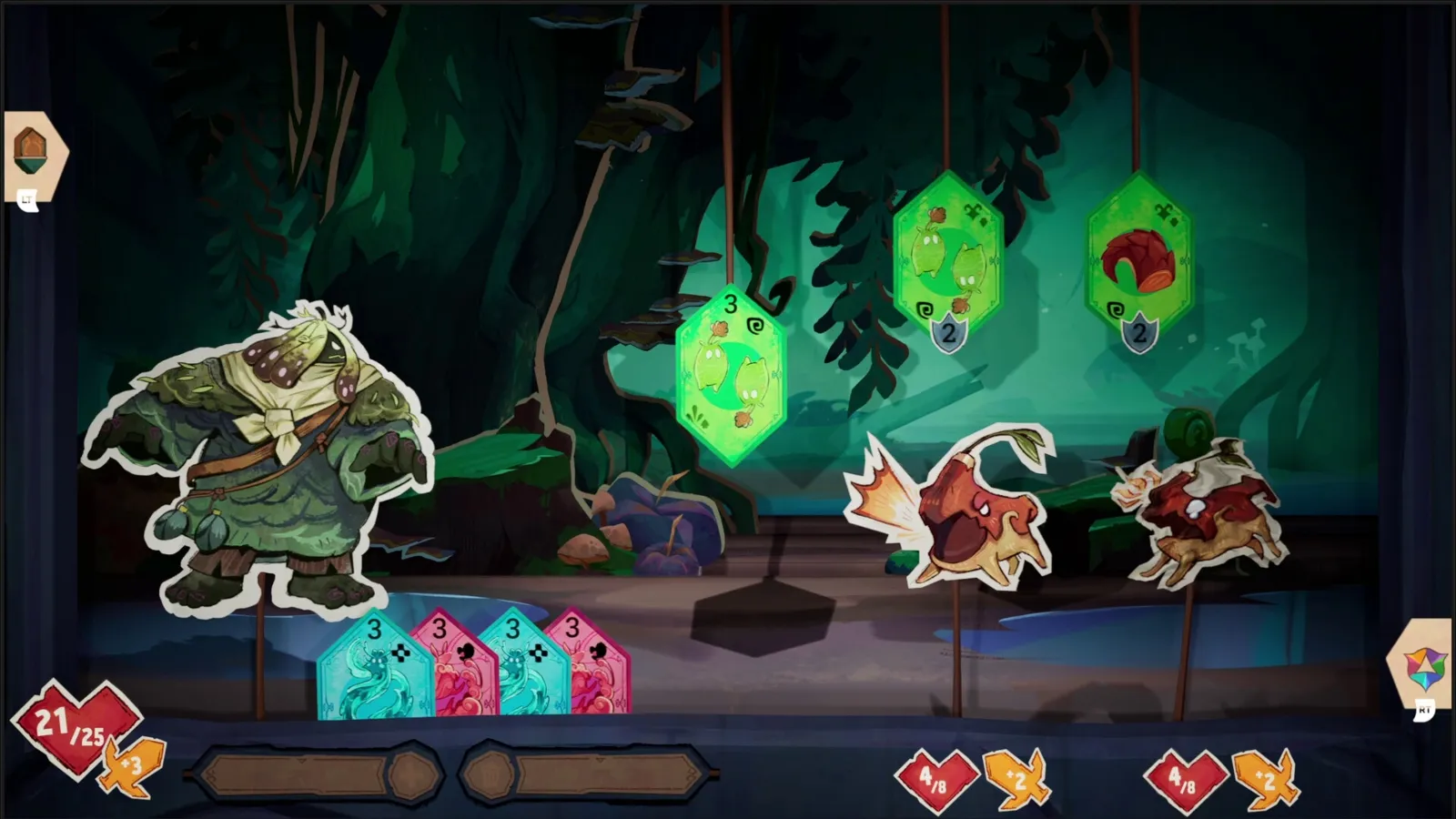
The turn-based battles see monsters play a card with a flavor suit, indicated by a color, and a number value. For example, an Umami card is green. Victory means playing a higher-value card of the same flavor profile as the monster. So in this example, I needed to play a green card with a higher number value. Winning a round deducts health points from the loser, based on my overall attack power, a separate metric indicated by a sword symbol. The dish I serve Oyshi grants a +3 attack power.
Enemy cards can be weakened by playing cards that balance their flavor. In this case, blue cards balance green ones, so playing the former will lower the latter's point value. You can also use cards to enhance the strength of others, based on a similar color-coordination comparable to Pokémon’s typing weaknesses/resistances. If you get understandably confused, a color wheel-like chart offers a simple visual breakdown of which flavors enhance or balance each other for easy reference. And if you’re not holding the cards you need to win a round, you can either discard your entire hand to draw five new cards or draw to fill empty hand spaces until you have five again. Otherwise, playing the wrong flavor card against an enemy will cause you to take the full brunt of their attack.
Although the combat system is a bit much to take in, I got the hang of the battles during the lengthy trek through the roguelike paths. It’s still ultimately my least favorite aspect of Beastro, at least during this early section, but it has the potential to evolve into something more engaging. Thankfully, I still enjoyed the cozier exercise of prepping ingredients, helping villagers, and running a restaurant. How these more leisurely activities evolve will be key, as the daily loop will need to be consistently engaging and surprising to keep me interested in the long haul. Beastro is a creative confluence of gameplay ideas, and I’m hoping it blends into an experience as rich and delicious as Panko’s dishes when it arrives in 2026. And if you can't wait until then, there's a Steam demo you can play right now!
On
On
Off
Off


Popular Content





![Remedy Explains Control Resonant's Most Memorable, Unexpected Sequence And Its [REDACTED] Inspirations](/sites/default/files/styles/teaser_promoted_image_thumbnail/public/2026/06/04/6db2d411/control-resonant-sgf-2026-7.jpg.webp)





Make Your
Bad signal or dead zones? Download your issues before you leave and read anywhere.