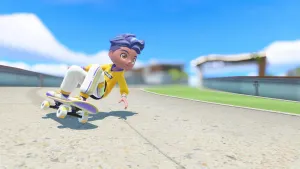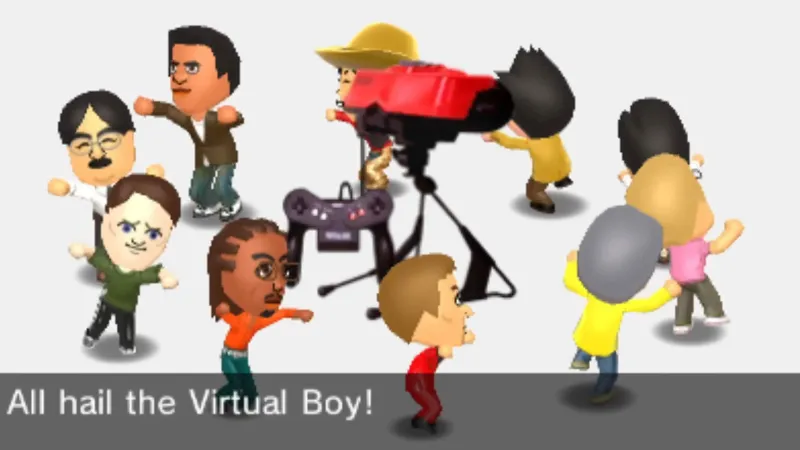
Tomodachi Life (3DS, 2014)

I have long been obsessed with the Virtual Boy. I have a vivid memory of seeing the device on display, which I believed was a portent of the future, at my local Sears when I was young. I was too short to see into the headset properly, but I desperately wanted to experience what could only be the future of video games. A few months later, it was as if it never existed. I never got to try it, and Nintendo, a company with an impressively short list of outright failures on its track record, was eager to pretend it never existed.
The first hint that Nintendo was beginning to feel slightly less embarrassed about the Virtual Boy arrived in 2014’s Tomodachi Life for 3DS, where one of the game’s bizarre dream sequences featured Miis dancing around a Virtual Boy. It was the first sign since the Virtual Boy launch that Nintendo was, potentially, willing to acknowledge its most embarrassing product, but I never would have predicted it would lead to what is ostensibly a full re-release.
Every few years, I would look at the device’s eBay prices until my wonderful wife decided to save me the trouble of checking periodically and bought me one. I relished the experience of finally getting to play it, awkwardly craning my neck to see what the future of 1995 looked like. I played and beat Virtual Boy Wario Land (and wrote about my experience for Polygon) and put the device away grateful that I got to answer the question of what playing the Virtual Boy was like that had been plaguing me since I was a child. And for the record, the answer was… mostly terrible!
I was flabbergasted when Nintendo announced its plans to not only release the Virtual Boy’s full library of games on Switch and Switch 2, but also release (admittedly overpriced) hardware that would allow you to play the games exactly as they were designed. It’s an insane proposition made exclusively for me, so I bought one the moment it was available. Nintendo also sent us one for review purposes, so now I have two in my house, plus my original eBay Virtual Boy, which means I don’t have a reasonable answer for when someone inevitably asks me, “What is wrong with you?”
Which is all an excessive amount of setup to actually talk about the new/old Virtual Boy for the Switch and Switch 2. The original Virtual Boy is a shockingly complicated piece of technology. I highly recommend YouTube channel The Slo Mo Guys’ video breaking down how it works. I promise it does not work how you think it does. But on Switch, it is a much more straightforward experience. It essentially works like a modern VR headset, displaying the game twice, once for each eye in a strange aspect ratio that the Virtual Boy headset’s lenses compensate for.
Compared to playing on an actual Virtual Boy, the Switch version with the headset is much sharper and better. And the stereoscopic 3D works! These games were in 3D years before the short-lived trend of 3D TVs or the 3DS. The effect was impressive all those years ago and is still impressive today. This is the cleanest way to play Virtual Boy games in 2026, but it doesn’t change or fix the important and undeniable fact that Virtual Boy games are uncomfortable to play and overall are not very good.
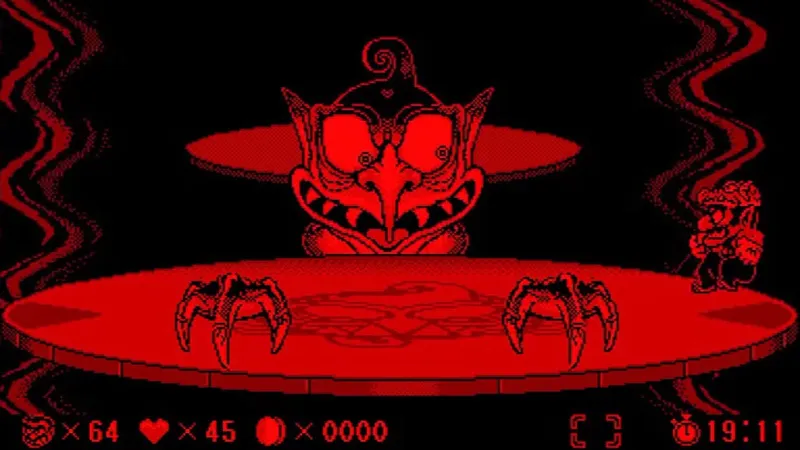
Virtual Boy Wario Land stands out as the shining exception. It’s a great entry in the Wario Land series of games. A classic 2D Wario platformer that would function as a fun game even without the impressive stereoscopic bells and whistles. You jump between the foreground and background and it looks and feels cool. The whole game takes place in underground caves so the dark red lines make sense in context, and the final boss is the kind of nightmare fuel we all would be reminiscing about as adults today had anyone actually played the game in 1995.
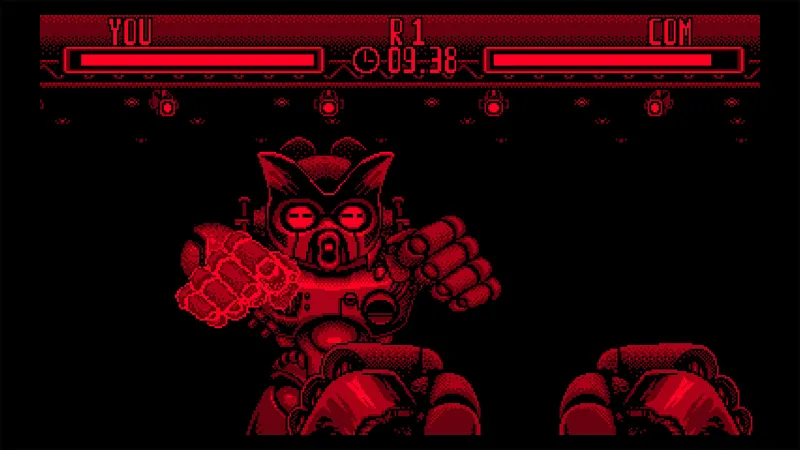
Teleroboxer is a functional, but not particularly good Punch-Out inspired fighter; Red Alarm is all wireframe and hard to parse; 3D Tetris is an interesting idea, but it gestures at the idea of a framerate instead of committing to one; and Golf and Galactic Pinball offer few surprises. The Mansion of Innsmouth stands out as a distant second behind Wario by being a weird horror game where you walk around hallways shooting scary monsters, but it is incredibly dated and doesn’t feel as three-dimensional as the other titles.
Every time you start a game, it asks if you want it to automatically pause for you so you can take a break every ten minutes, which is frankly all you need to know about the experience of playing Virtual Boy. It’s uncomfortable, extended play hurts your eyes, and Nintendo knew this, which is why every game builds in that functionality.
It’s a bad time.
But, with all that said, and with my overt warnings about the anti-comfortability of playing any Virtual Boy game, I can’t help but be absolutely charmed by its existence. I am grateful that Nintendo is acknowledging what is inarguably its worst video game console, and putting in a substantial amount of effort toward making it playable exactly as it was in 1995 in the year 2026. I love video game history and especially Nintendo history, and I want Nintendo to embrace both its successes and failures just like this.
Now, all Nintendo needs to do is release its handful of CD-i games into its Switch library – another aspect of Nintendo history I am absolutely obsessed with – and I will finally, truly be happy.
@game_informer We got the new, but also old, Virtual Boy for Switch. It is without a doubt a rerelease of Nintendo’s worst console. But we love that it exists. #nintendo #virtualboy ♬ original sound - Game Informer

Bad signal or dead zones? Download your issues before you leave and read anywhere.