interview

Team Ninja Answers Our Burning Questions About Nioh 3's First Story Expansion, Hell Rising
Nioh 3 was one of our favorite games from the early months of 2026, and the jumbo-sized adventure is getting a substantial story expansion called Hell Rising this week, August 19. Hell Rising introduces a new map set in the Keian era in 1651 following the death of shogun Takechiyo, as well as new enemies, weapons, equipment, and more.
Following the expansion's reveal, we had several questions about Hell Rising's story (is protagonist Takechiyo really dead?), its overall size, and how its new systems complement the existing features. To elaborate on what Hell Rising brings to the table, we asked Team Ninja project manager Kohei Shibata, Nioh 3 game director Masaki Fujita, and level designer Atsushi Takahashi over email, who provided further details on what players can expect.
Game Informer: How did you feel about the reception to Nioh 3, particularly how its "open field” design was received?
Kohei Shibata: We feel that many players have responded positively to the great synergy between Nioh and the open-field format. Crafting level designs that captured the signature tension and intensity of Nioh’s combat was a major challenge during development, but we packed in a wide range of ideas, and I am genuinely happy to see that effort bear fruit.
Was Hell Rising designed to address any specific player feedback from Nioh 3’s base campaign, and how does it, if so?
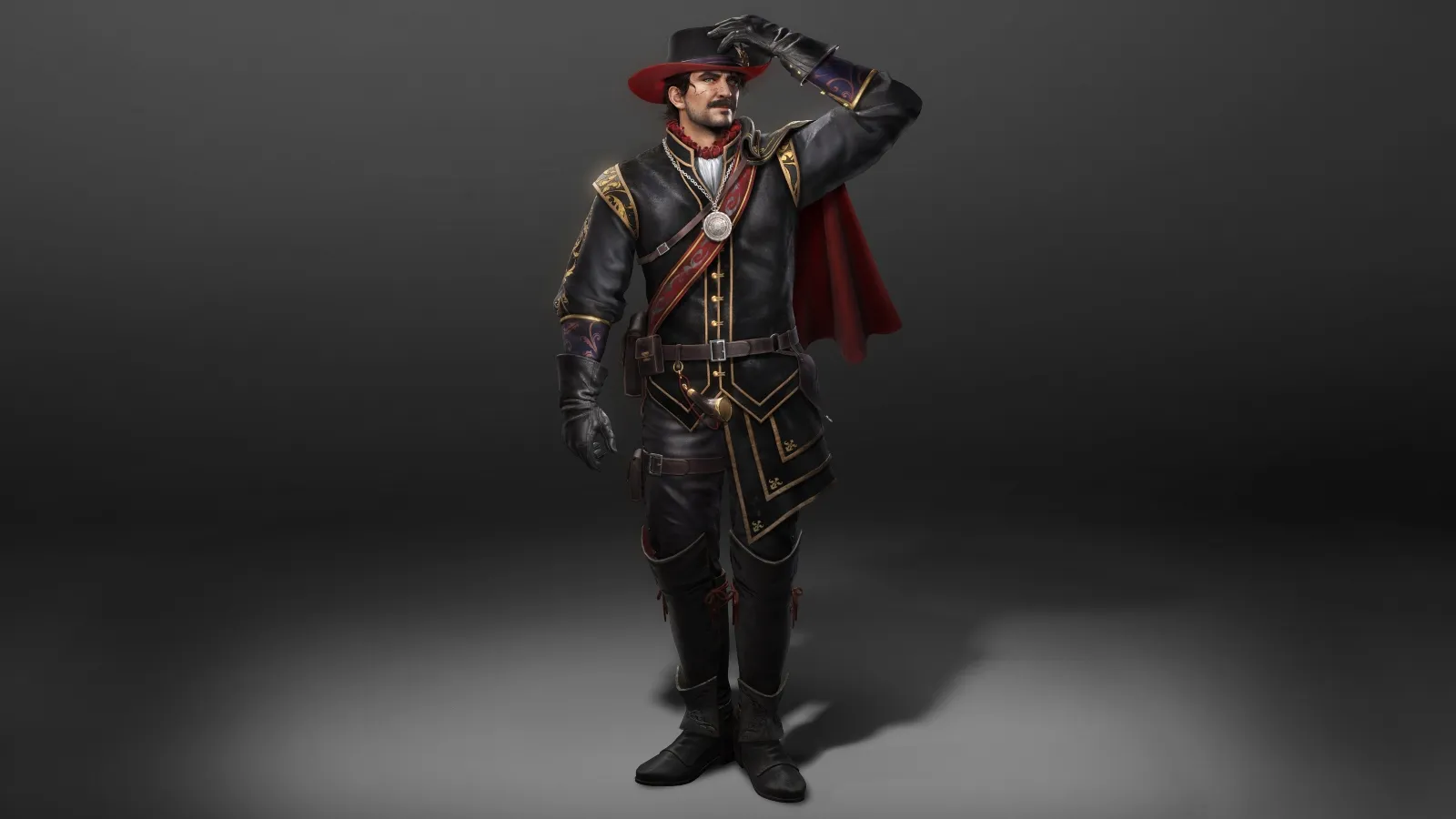
Masaki Fujita: Yes, the feedback we received for the base game of Nioh 3 has been incorporated into the DLC. For example, we’ve added pistol-based combat —which many players requested — as a new ninjutsu technique. On the loot-hunting front, high-value special effects will now be randomly applied to gear, allowing players to enjoy a deeper level of gear curation. In terms of the story experience, the DLC features documents such as letters and notes that can be discovered throughout the field. Reading these allows you to learn more about the characters, uncover the backstory behind events, and get a sense of the culture and customs of the people of that era.
Why did you set Hell Rising during the Keian Era? What are some key historical events or locations from the time that will be represented in-game?
Fujita: When it was decided that the theme would be “Shogun” and that Takechiyo, the grandson of Tokugawa Ieyasu, would be the protagonist, we also broadly determined what the main story and the DLC would cover. The main story is “the story of the protagonist becoming shogun,” while the DLC is “the story of what the protagonist accomplishes after becoming shogun.” When we think of historical figures who actually served as shogun, we tend to think about what they did. We felt that only by addressing what the protagonist accomplished as shogun could we properly bring a story centered on the theme of the shogun to a conclusion.
The Keian era is the period immediately following the rule of the protagonist Takechiyo as the Shogun. The incidents that occurred during that time were strongly influenced by Takechiyo’s rule. In this title, he travels through time into the future, where he comes to witness both the light and darkness of his own rule. We hope players will see how that experience is ultimately put to use in the conclusion encompassing both DLC 1 and DLC 2.
A pivotal historical event of the Keian era is the attempted rebellion led by Yui Shosetsu and his faction. While the historical plot was suppressed before the rebels could mobilize, the game depicts a scenario where they harness the power of Hell to summon yokai and launch an uprising; this results in widespread destruction across Edo and an assault on Edo Castle, the Shogun's stronghold. Both Edo Castle and the city of Edo serve as the playable areas for this DLC.
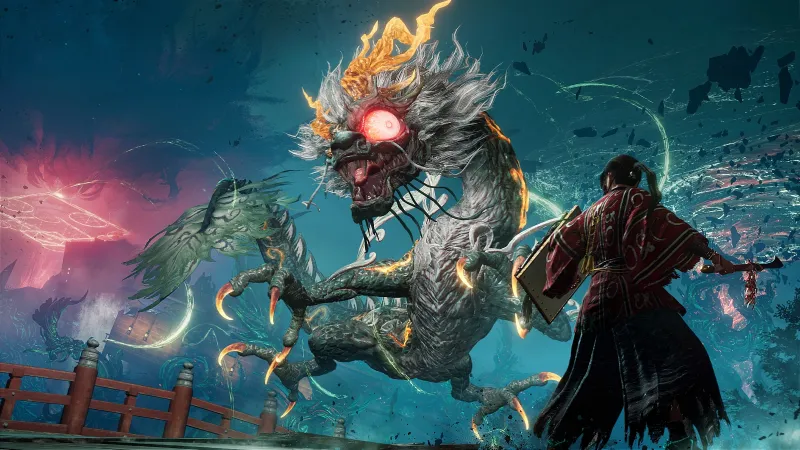
I did a double take when I saw that Takechiyo dies; is that accurate? If so, who will players control in Hell Rising and why did you decide to kill off the protagonist?
Fujita: The year 1651 CE — the setting of Hell Rising — was a time of political instability, marked by the death of the Shogun and the recent ascension of a young successor to the shogunate. In other words, the story takes place after Takechiyo’s death, following a journey across time. Since the character the player controls is a version of Takechiyo who has traveled forward from the past, the protagonist of the main story does not, strictly speaking, meet his end.
Does Hell Rising require starting with a fresh character, or do our loot/abilities from the base campaign carry over?
Fujita: As mentioned above, the character players control is Takechiyo, who has traveled through time from the past; therefore, players will play using data carried over from the main game.
Can you name some specific benefits the Hundred Demon Realms Picture Scrolls provide, and how do they complement the already dense list of abilities?
Fujita: As the “Hundred Demon Realms Picture Scroll” will be added as a new category of equipment, players will equip a scroll in addition to their existing gear, further strengthening their character through the special effects it provides. Some of the special effects found on scrolls are similar to those available on existing equipment, but there are also several unique special effects that can only be found on scrolls. These include a group of special effects that require specific attributes, such as Valor or Heart, to reach a certain value before they can be activated, as well as a special effect that allows multiple Mastery Skills — which normally can only be activated one at a time — to be active simultaneously. These will have a significant impact on character builds. In addition, scrolls of Divine rarity will come with a Grace. This will allow players to gain one additional tier of a Grace’s set bonus, meaning that scrolls will also have a major impact on builds in this regard.

How big is Hell Rising, both in the size of the map compared to the current maps and the estimated length to complete?
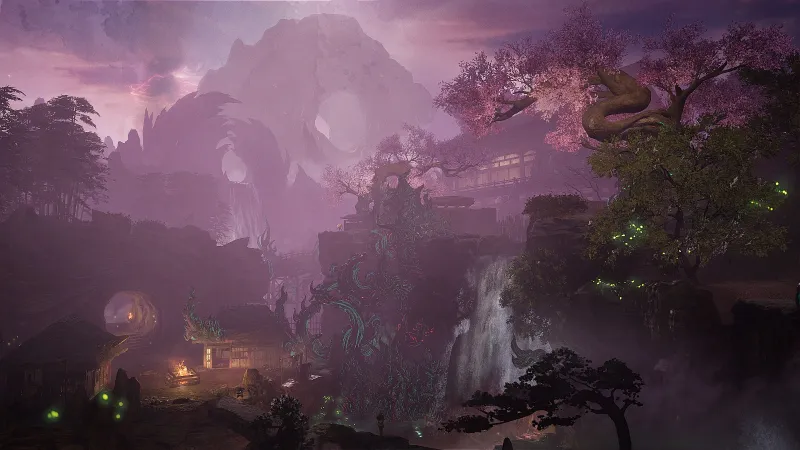
Atsushi Takahashi: In terms of scale, it is comparable to the Heian section of the main game. It will take more than 10 hours to complete “Edo-Keian,” while “Hell Rising” as a whole offers over 30 hours of content when including additional replay elements such as the newly added third playthrough. The open-field of “Edo-Keian” also features familiar locations such as Kanda and Ueno, as well as several distinct areas, including a massive aqueduct from which a local place name is derived, a multi-layered network of underground waterways, and a volcanic region where powerful enemies await. In addition to the level of challenge expected from a soulslike game, players can also enjoy the visual variety offered by these locations.
How does using the Hoko and Shield differ between the Samurai and Ninja styles?
Takahashi: The defining feature of the “Hoko and Shield” is its integration of offense and defense. Conventional combat involves guarding against or evading an enemy’s attack, then striking during the opening that follows. Unlike a parry, which deflects an attack by carefully judging the enemy’s timing, the Hoko and Shield allows players to block the attack and immediately drive their own attack into the enemy.
The samurai’s “Hoko and Shield” is a weapon that seamlessly combines offense and defense. By unleashing a strong attack or certain Active Skills in time with an enemy’s attack, players can deflect the blow with the shield while striking with the hoko. This allows them to engage even the most formidable foes head-on, outmaneuver them in a direct exchange, and drive them into a corner.
By contrast, the ninja’s “Ninja Hoko and Shield” is a highly versatile weapon. The shield can not only be used to deflect enemy attacks, but also thrown or even ridden, while being combined with attacks from the hoko. Players can move freely in every direction and bewilder their enemies by, for example, leaping into the air while performing techniques and hurling the shield down from above.
Can you elaborate on what the divine-rarity Grace set bonuses are and the benefits they provide?
Fujita: “Graces” are set bonuses randomly assigned to equipment of Divine rarity. By equipping multiple pieces of equipment bearing the same Grace, players can activate up to six special effects depending on the number of pieces equipped. In “Enlightened One's Journey,” the third-playthrough difficulty level added in the DLC, new Graces that did not appear within the scope of the main game will be introduced. These are primarily designed to strengthen builds that have previously been unable to demonstrate their full potential, such as builds specializing in a particular element, Onmyo, or Living Artifact. Powerful set bonuses have been prepared to encourage players to reconsider the builds they used through their second playthrough.
Hell Rising will be available for Nioh 3 on August 19 for PlayStation 5 and PC.
On
On
Off
Off