
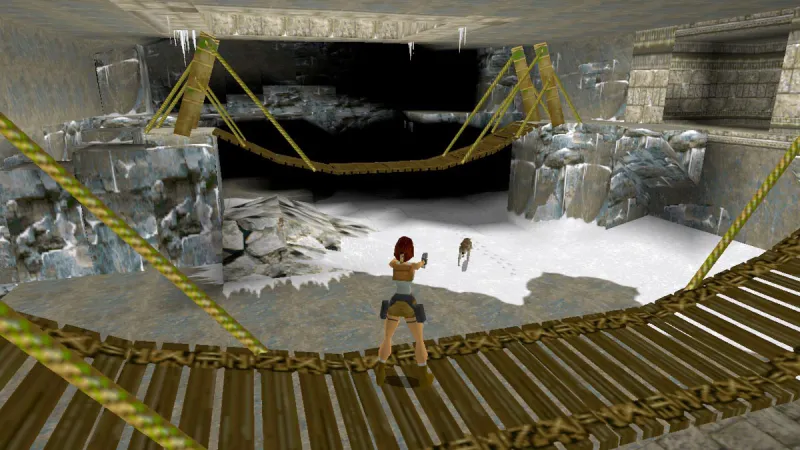
Tomb Raider (1996)

For 30 years, Tomb Raider has endured as one of video games’ most legendary and recognizable franchises, both among gaming enthusiasts and pop culture. In an era when games were dominated by male protagonists and 3D gaming was in its infancy, Lara Croft’s 1996 debut skyrocketed her to fame as one of the most recognizable video game protagonists while laying important groundwork for the medium’s future. Three decades across multiple eras, rife with successes, setbacks, and reinventions, have only solidified Lara’s iconic status and proven that her current stewards at Crystal Dynamics are as resilient as she is. Before we look ahead to Tomb Raider’s future, we reflect on the series’ journey so far with some of the minds behind Lara’s many adventures.
“I was a big fan of an old first-person game called Ultima Underworld, and I wanted to mix that type of game with the sort of polygon characters that were just being showcased in Virtua Fighter,” Toby Gard, a Core Design studio designer often credited as the key mastermind behind Tomb Raider and, even more so, Lara Croft herself, told the BBC in a 2001 interview. “I thought by mixing that up we could make it a sort of real-time interactive movie and that was basically the concept for Tomb Raider.”
Crafted in roughly 18 months at developer Core Design’s Derby, England, headquarters, Tomb Raider landed on the original PlayStation, Sega Saturn, and PC to critical acclaim. Starring wealthy archaeologist/adventurer Lara Croft on a globe-trotting quest to retrieve an Atlantean artifact, the game was hailed for its revolutionary third-person 3D action, stunning-for-the-time graphics, powerful sense of atmosphere and mystery, and, of course, the appeal of its star.